
Menu
At Nordic Balance, we see the same patterns every year: most injuries come down to training error, usually doing too much, too soon without the right movement support around it. And whilst our team of physios and sports therapists are highly experienced treating MSK injuries related to running, our best advice is to try to avoid them altogether. That’s where the concept of “prehabilitation” comes in.
We’re all about helping you protect race day, and every run leading up to it.
In this guide, we’ll explain:
– Why most running injuries are preventable, and what really causes them
– How load management and recovery shape long-term performance
– What prehabilitation actually involves in practice
– Why personalised movement assessment matters more than generic training plans
– How building resilience improves both injury resistance and running efficiency.
What is Prehabilitation?
Put simply, prehabilitation is all about preparing the body for stress before that stress peaks. This could be an upcoming surgery, a sports event like a marathon or triathlon, or your regular weekly training sessions.
For runners, prehabilitation means actively improving mobility, strength, tissue resilience and recovery capacity before pain or injury develops.
Prehab isn’t about fixing pain. It’s about preventing it before it starts.
In practical terms, this can include:
– Joint mobilisation techniques to improve range of motion
– Targeted strength and stability work to address muscular imbalances
– Soft tissue therapy such as sports massage to maintain tissue quality
– Load management planning with a physiotherapist
– Movement screening and biomechanical assessment to identify risk factors early.
These are not generic exercises pulled from the internet, they are tailored interventions based on how your body moves.
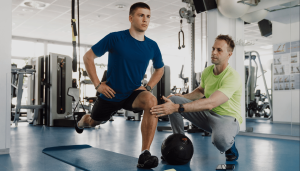 Whilst prehabilitation is relevant to daily life and activities, running is one of the most popular forms of exercise, and typically where we see the most issues arise.
Thousands of people take up running every year, and although it is an excellent form of exercise, unfortunately the majority of running-related injuries occur due to sudden increases in activity or load. E.g. suddenly going from 5K to training for a half or full marathon.
In fact, it is estimated that 50% of regular runners annually suffer at least one injury. At any given point in the year, 25% of regular runners cannot perform due to physical issues.
The good news? Most of these injuries are preventable with the right planning and support.
The body adapts to stress, but only when that stress is applied progressively. Sudden spikes in mileage, pace or intensity are where most problems begin.
There is no universal running plan. There is only the right plan for your body.
Running injuries rarely happen in a single dramatic moment, they build quietly over weeks of accumulated load.
This includes several common issues such as ACL tears, Plantar Fasciitis, bursitis, tendonitis, muscle strains and stress fractures, all typically linked to overload or poor movement control.
Starting small and progressing gradually is the key. Allow your body to rest between sessions so that muscles, bones, ligaments, tendons, lungs and heart can all improve safely.
A training plan should always be based on three factors: exercise, diet and recovery, striving to create the right balance between them.
Prehabilitation exercises may include stretching, foam rolling, dynamic joint mobilisation and strengthening exercises tailored specifically for runners.
For example, this might involve:
– Hip stability drills to reduce knee strain
– Calf loading programmes to protect the Achilles tendon
– Glute strengthening to support pelvic control
– Core stability work to maintain posture under fatigue
– Ankle mobility exercises to improve shock absorption
Prehab can also focus on conditioning the cardiovascular system while improving muscular endurance using controlled plyometrics.
Improving range of motion and correcting imbalances doesn’t just reduce injury risk, it improves running efficiency and economy.
Better movement equals less wasted energy, and that matters over 5K or 26.2 miles.
Consistency is what makes runners stronger. Prehabilitation protects that consistency, so you’re not forced to stop just as you’re building momentum.
If you want to build prehabilitation properly into your training, expert guidance makes the difference. At Nordic Balance, prehabilitation for runners often combines several of our core services:
– Physiotherapy-led functional movement screening to assess joint mobility and muscle activation patterns.
– Detailed biomechanical assessment to identify load inefficiencies.
– Strength-based rehabilitation programmes designed to improve running mechanics.
– Sports massage to reduce tissue and muscle tension and support circulation to speed up recovery post run.
– Shockwave Therapy for faster repair and pain reduction in tendinopathies e.g. achilles or plantar fasciitis.
– Dry needling where muscular overactivity is limiting efficient movement.
– Ongoing progress reviews to ensure load increases safely and sustainably.
Rather than waiting for pain to dictate your training, we help you build durability and resilience into your programme from the outset.
With the right mobility work, strength training, recovery strategy and professional oversight, most injuries can be significantly reduced.
Prehabilitation isn’t about being cautious. It’s about being smart. If you’re training for an event,or simply want to keep running without interruption, building a structured prehab plan could be the difference between finishing strong and sitting out injured. Contact our team today on 0208 922 0495 to discuss treatment plans designed around you.
Stretching Before a Run
Foam Rolling Tutorial
Dynamic Joint Mobilisation Exercises
Simple Strengthening Exercises for Runners
Nordic Balance offers 5-star-rated physiotherapy clinics in Battersea, Clapham, Wimbledon and St James’s, Central London. For more information about our range of injury recovery and prevention treatments, including physiotherapy, osteopathy, chiropractic, podiatry, and sports massage, call us on 0208 090 0043.
June 13th 2024
After what felt like an eternity way too many dealings with solicitors and the local council more grey hairs and a glass of wine or to calm the nerves we've finally managed to have our second baby Nordic Balance Abbeville Road Located on Abbeville Road Clapham our lovely new injury...
READ MOREJune 13th 2024
TMJ dysfunction TMD can cause more than just jaw pain it can lead to headaches muscle tightness and difficulty chewing or speaking comfortably While many people turn to painkillers or mouthguards these solutions only mask symptoms rather than addressing the underlying cause Acupuncture a well-established non-invasive treatment offers an alternative...
READ MOREJune 13th 2024
Guest post by span style text-decoration underline span style color ff text-decoration underline a style color ff text-decoration underline href http londonlactationconsultants co uk who-we-are Sharon target blank rel noopener noreferrer Sharon George a span span and span style text-decoration underline span style color ff text-decoration underline a style color...
READ MORE