
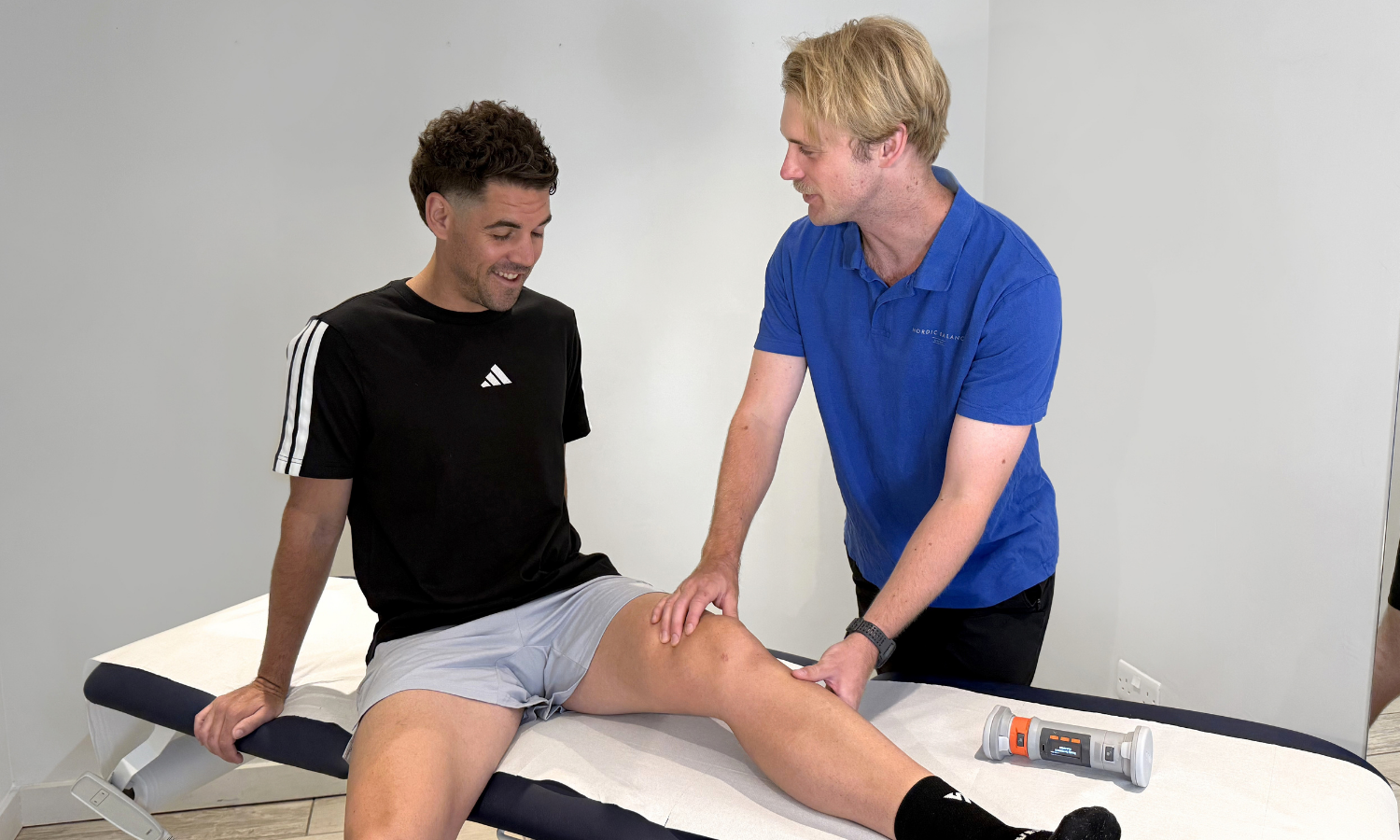
Guest speaker: Claire Robertson
Patellofemoral pain is common, but that does not make it straightforward. The same area of knee pain can be influenced by training load, strength, movement, previous injuries, pain beliefs and how someone interprets what they are feeling.
This CPD with specialist physiotherapist Claire Robertson focused on improving how we assess and manage patellofemoral pain and infrapatellar fat pad presentations. The emphasis was on stronger clinical reasoning, clearer patient education and rehabilitation that responds to the demands of the person in front of us.
Quick links
- Patellofemoral pain assessment and the role of imaging
- Patient education, pain beliefs and knee crepitus
- Subjective assessment and differential diagnosis
- Load management for patellofemoral pain
- Strengthening for patellofemoral pain
- Running rehabilitation for patellofemoral pain
- Infrapatellar fat pad assessment and management
- Patellofemoral pain in adolescents
Patellofemoral pain assessment and the role of imaging
One of the main themes from the session was to avoid letting imaging dominate the clinical picture.
MRI findings can provide useful information, but they do not automatically explain why someone is in pain or what will help them improve. Claire encouraged the team to place greater emphasis on the patient’s history, symptom behaviour, activity levels and wider physical and psychological context before deciding which findings are relevant.
This means asking more than simply, “Where does it hurt?”
How did the problem begin? What activities make it worse? What has changed in training? Is pain present during sitting as well as movement? Are there previous hip, back or ankle problems? What does the patient believe is happening inside the knee?
Those answers can shape the rest of the assessment far more effectively than starting with a generic list of physical tests.
Patient education, pain beliefs and knee crepitus
The language used to describe knee pain can influence how confident someone feels about moving it.
Claire discussed the problems that can arise when patients are given structural labels that suggest the knee is worn, damaged, or fragile.
Terms such as chondromalacia patellae, for example, may reinforce a damage-focused interpretation without helping the patient understand what to do next.
Knee noise was another important part of the discussion.
Clicking, grinding or creaking can quickly become something a patient monitors every time they squat, use the stairs or stand from a chair. The more attention it receives, the easier it is for normal joint noise to become associated with danger.
The session explored how clear education can reduce this fear and help patients understand that noise alone does not automatically mean the knee is deteriorating.
Addressing fear of movement
Pain can change behaviour long before it changes strength. Patients may stop bending the knee, avoid stairs, or stop exercising because they worry about causing further damage. Online searching can sometimes reinforce those concerns.
The team discussed the importance of exploring those beliefs directly rather than assuming the only problem is physical.
Good rehabilitation therefore includes helping the patient understand what movements are safe, what symptoms mean, and how to rebuild activity gradually.
Subjective assessment and differential diagnosis of anterior knee pain
The subjective assessment should guide the next steps. Different activities can provide different clues about what may be contributing to anterior knee pain.
The session explored the significance of symptoms during:
- Prolonged sitting
- Flat-ground walking
- Walking uphill
- Going up and down stairs
- Running
- Loaded knee bending
- Everyday activities outside sport.
The aim is not to diagnose a knee condition from one aggravating movement. It is to use the symptom pattern to decide which structures, movements, and contributing factors deserve closer assessment.
Screening the hip, back and ankle
Pain at the front or inside of the knee does not always originate solely from the knee.
Claire highlighted the value of screening the hip, back and ankle when the history suggests they may be relevant.
Previous ankle injuries may influence how someone loads the lower limb. Hip joint problems can sometimes refer pain towards the knee. Back symptoms may also change the clinical picture.
That does not mean every patient needs a full-body assessment.
It means the clinician should know when the story gives them a reason to look beyond the painful area.
Identifying neuropathic or highly sensitive presentations
The team also discussed symptoms that do not behave like straightforward mechanical knee pain.
Sensitivity to clothing or light touch, for example, may suggest a more complex pain presentation and warrant further neurological screening.
Recognising this early can prevent clinicians from repeatedly applying more local treatment to an area that is already highly sensitive.
Load management for patellofemoral pain
Patellofemoral pain is often influenced by the amount and type of load placed through the knee. That makes it important to understand everything the patient is doing, not simply the activity they mention first.
A runner may also be strength training. A teenager may have PE, football, gym sessions and weekend competition. A parent may be combining exercise with hours on their feet at work.
All of that contributes to the overall demand on the knee. Load management is therefore less about telling someone to stop activity and more about deciding what can stay, what needs modifying and what the knee needs more capacity to tolerate.
Strengthening for patellofemoral pain
The CPD moved away from the older idea of isolating one small part of the quadriceps, such as the VMO, as the main solution to patellofemoral pain.
Instead, Claire emphasised developing overall quadriceps and gluteal strength.
The aim is to build enough capacity through the whole lower limb to tolerate the demands of everyday movement, running and sport.
Exercises should be challenging enough to create a meaningful strength stimulus, with the exact programme shaped around the individual rather than a standard set of knee exercises.
Exercise range and patellofemoral joint load
The range used during an exercise can change how demanding it feels at the patellofemoral joint.
The session explored ways of modifying knee angle during both closed-chain exercises such as squats and open-chain exercises such as knee extensions when symptoms are particularly irritable.
Specific ranges discussed included:
- Closed-chain exercises: approximately 0–50° during more sensitive stages
- Open-chain knee extension: approximately 90–45°
These were presented as ways to change load, not as permanent restrictions.
As symptoms and strength improve, rehabilitation should progressively prepare the knee for the fuller ranges required in everyday life and sport.
Running rehabilitation for patellofemoral pain
Stopping running completely is not always the only option.
For some runners, adjusting how much they run or changing specific aspects of their running can reduce symptoms while strength and capacity rebuild. The session looked particularly at running cadence.
Using running cadence to modify knee load
Claire discussed trialling a modest increase in step rate for selected runners.
A small cadence increase can shorten stride length and alter the load experienced around the knee. The session discussed changes of around 6–10%, often introduced gradually with a metronome.
This is not about imposing one ideal running style. It is a clinical tool that may help someone remain active with fewer symptoms when changing running mechanics helps.
We also discussed downhill running and running with significant swelling as situations where load may need to be reduced temporarily.
Infrapatellar fat pad assessment and management
The infrapatellar fat pad is a sensitive structure at the front of the knee and can contribute to pain that may initially resemble other patellofemoral presentations.
The CPD explored how symptom behaviour can help clinicians decide when to consider fat pad involvement.
This included paying attention to pain during lower ranges of knee flexion, tenderness around the infrapatellar region and symptoms during apparently low-impact activities such as walking or standing.
Precise assessment matters because different sources of anterior knee pain may require different approaches.
Managing an irritable fat pad
When fat pad symptoms are particularly sensitive, the immediate aim may be to reduce repeated irritation while maintaining as much useful movement as possible.
The team discussed altering exercise ranges, adapting running and avoiding unnecessary local irritation.
The session also covered the importance of identifying presentations with possible neuropathic sensitivity, where repeatedly treating the painful area directly may not be appropriate.
Any injection decisions were considered something requiring careful case selection rather than a routine first-line approach.
Patellofemoral pain in adolescents
Assess adolescent knee pain in the context of a young person’s entire week. A teenager may be involved in several activities without thinking of the total amount as “training”.
The session encouraged clinicians to ask about:
- School PE
- Club sport
- Weekend competition
- Gym sessions
- Hobbies
- Walking and commuting
- Recent changes in training
- Sleep
- Growth-related knee symptoms
- Hip pain
- Previous ankle or back injuries
Managing total activity load in young athletes
Reducing load does not have to mean removing every sport. Claire discussed identifying which activities matter most to the young person and, where necessary, temporarily reducing the least important demands.
This allows rehabilitation to create some breathing room without making the patient feel as though being active is itself the problem.
The team also discussed screening for conditions associated with the growing athlete, including Osgood-Schlatter disease and hip pathology where symptoms suggest further assessment is needed.
Clinical changes following the CPD
The session produced several practical changes the team could take straight into clinic.
These included:
- Letting subjective findings guide objective testing
- Asking more about previous ankle and back injuries
- Screening hip movement when clinically relevant
- Assessing total activity rather than one sport in isolation
- Asking patients what they believe knee clicking or grinding means
- Exploring fear of movement rather than focusing only on strength
- Prioritising overall quadriceps and gluteal capacity
- Modifying exercise ranges when symptoms are particularly irritable
- Considering running cadence and other load changes where appropriate
- Avoiding generic assessment checklists that do not respond to the patient’s presentation
The common thread was better clinical reasoning.
Not more tests for the sake of testing. Not more exercises because a template says so.
A clearer understanding of the patient first, followed by assessment and rehabilitation that answer the questions their presentation actually raises.
Continued professional development at Nordic Balance
CPD at Nordic Balance is intended to change practice. Bringing specialist clinicians such as Claire Robertson into the team gives our practitioners the chance to question established approaches, compare clinical reasoning and explore how current thinking can be applied to real patients.
That shared learning matters in a multidisciplinary environment. Physiotherapists, osteopaths, sports therapists and coaches may see the same problem from different angles, and CPD creates space to bring those perspectives together.
The aim is not simply to leave with more information. It is to leave with better questions, sharper judgement and more useful ways to help patients move forward.
Interested in developing your career with Nordic Balance? Explore our current opportunities.