
Good treatment is not simply about knowing more techniques. It’s about knowing when to use them, when to change approach, and how to make rehabilitation realistic for the patient.
This CPD brought our clinical team together to explore two challenges that come up regularly in practice: adapting manual therapy when someone is acutely painful or guarded, and keeping rehabilitation moving when time, confidence, cost or an overwhelming exercise programme become barriers.
The two subjects might appear quite different. In practice, they share the same principle: treatment works better when it responds to the patient rather than expecting the patient to fit the treatment.
Treating acute pain without simply pushing harder
Someone arriving with acute pain can move very differently from normal. They may brace, avoid certain positions or tense before a movement has even begun.
That does not automatically mean the answer is stronger pressure or more aggressive treatment.
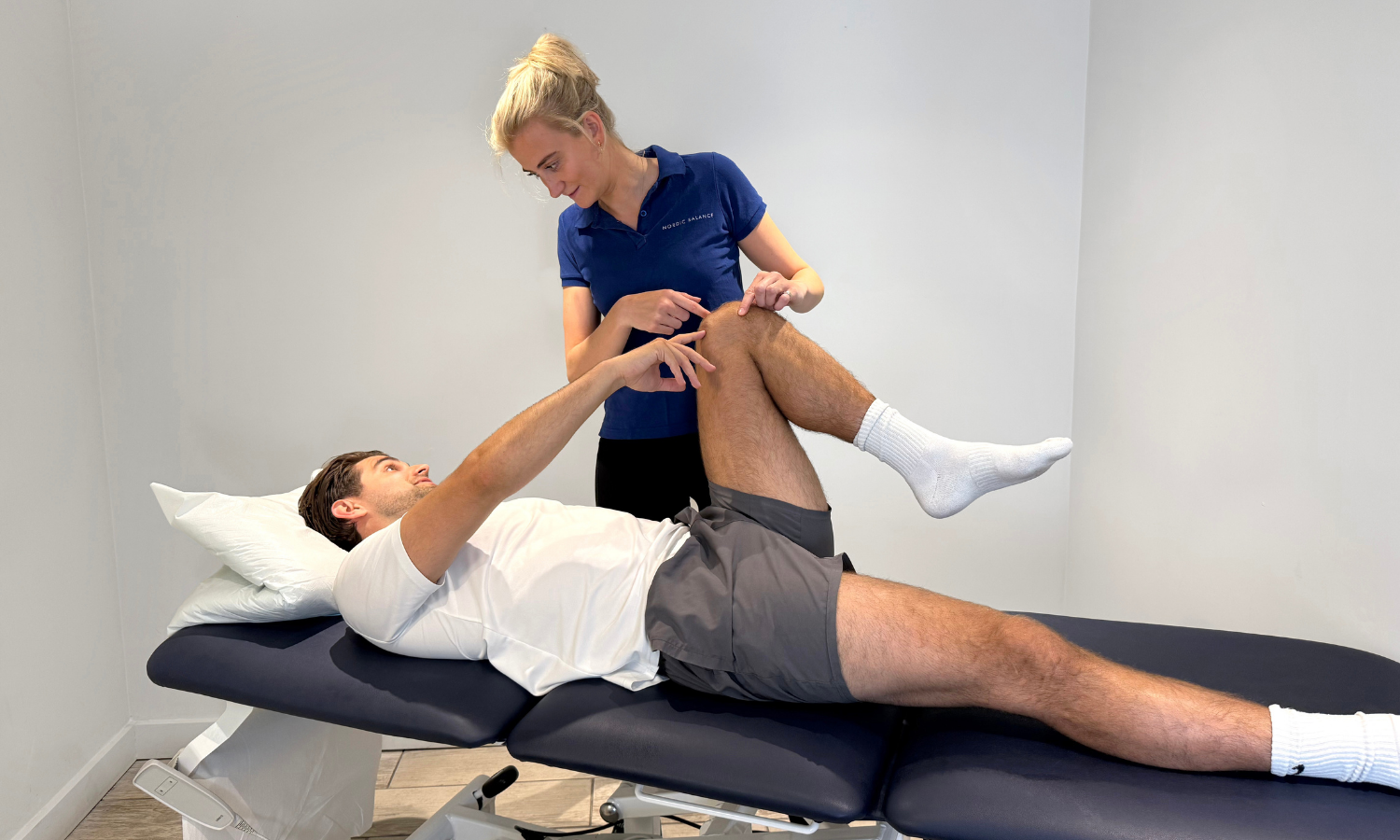
During the CPD, the team explored ways to adapt hands-on treatment to how irritable the presentation was on that day. This included supported positions, shorter-lever movements, treatment around rather than directly through highly sensitive areas, breathing strategies and gentler mobilisation.
The objective was not to “force” normal movement back. It was to find a starting point the patient could tolerate and use that to create more movement options.
This fits with the broader evidence around musculoskeletal care. NICE recommends that manual therapy for low back pain is used as part of a wider treatment package that includes exercise rather than as an isolated intervention. Neck pain guidelines similarly favour multimodal management rather than relying on a single passive technique.
That distinction matters. Hands-on treatment can be useful, but it needs a purpose within the wider rehabilitation plan.
Adapting manual therapy across the body
One practical part of the session looked at how that principle changes across different areas of the body.
For acute neck presentations, the team explored working through supported movement and the thoracic region rather than repeatedly challenging an already sensitive neck.
For shoulder pain, discussion centred on reducing guarding through supported mobilisation and broader work around the shoulder girdle rather than chasing the painful point with heavy pressure.
With acute lower back pain, clinicians explored alternative treatment positions, diaphragmatic breathing and working with surrounding regions such as the glutes, hips and trunk when direct treatment was poorly tolerated.
The lower limb brought another clinical question into focus: does a joint genuinely lack movement, or is the person protecting it because movement currently feels threatening or uncomfortable?
These approaches came directly from the techniques discussed within the Nordic Balance CPD. We should be careful not to claim that any one of them is universally superior. Contemporary research into neck mobilisation, for example, reports considerable uncertainty around the size of its effects when considered in isolation. That is precisely why clinical reasoning matters.
Joint stiffness & protective muscle guarding
Something can feel stiff without stiffness being the whole problem. If the surrounding muscles are guarding a painful area, simply pushing further into the restricted movement may not address what is limiting it.
The team explored assessment and treatment strategies for the ankle, knee and hip that could help practitioners think more carefully about that distinction. Gravity-assisted mobilisation, Muscle Energy Techniques and gentler approaches to swelling were among the techniques discussed.
The important learning was not a new test for categorising every restriction. It was to avoid assuming that “less movement” automatically means “this joint needs to be pushed further”.
Assessment comes first. What happened? What movements are difficult? How irritable is the area? What changes when the position, load or support changes? Those observations help determine what treatment is actually trying to achieve.
Making rehabilitation realistic
The second half of the CPD moved from what happens on the treatment bed to what happens during the other 167 hours of somebody’s week.
A rehabilitation programme can be perfectly designed on paper and still be useless if the patient cannot realistically follow it.
Work gets busy. Children need collecting. Training schedules change. People forget exercises. Sometimes five exercises simply feel like five more jobs at the end of an already full day.
Research into musculoskeletal rehabilitation supports taking those individual barriers seriously. A 2023 review identified factors including self-efficacy, social support and how people perceive the task itself as relevant to home-exercise behaviour. It also highlighted problem-solving and clear instruction as commonly applicable behaviour-change approaches.
A 2024 study looked at 19 previous reviews on physiotherapy adherence. It found that simple strategies such as supervised exercise, gradual progression and follow-up sessions can help people stick with rehabilitation, although the evidence is still mixed.
That reinforces something our clinicians see every day: the plan needs to work in real life, not just in the treatment room.
Fitting rehabilitation into a busy day
The team explored the idea of small “movement snacks” and attaching rehabilitation to things someone already does.
Instead of adding another substantial exercise session, a clinician might look for opportunities within the existing day. A short exercise could sit between meetings, become part of a morning routine or replace something in an existing gym warm-up.
The point is not that three minutes beside a desk is magically better than a structured rehabilitation session.
It is about reducing friction.
If somebody repeatedly tells us they cannot fit their rehabilitation into their week, prescribing more of the same is unlikely to solve the problem. The better clinical conversation is:
What can we change so the important work actually gets done?
That might mean fewer exercises, different exercises, a different dose, or simply agreeing which one or two things matter most right now.
Removing the guilt from missed exercises
This was one of the most useful discussions from the session. Patients do not always do their exercises, and that should not turn their next appointment into a confession.
If someone arrives apologising because they have not followed their programme, the useful information is not that they have “failed”. It is that something about the plan, their circumstances or their understanding made it difficult to follow.
Perhaps there were too many exercises. Perhaps one hurt. Maybe the instructions were unclear. Or perhaps work and family life simply took priority that week.
Research into exercise adherence supports a more individual approach rather than treating adherence as a simple question of motivation. Reviews have identified problem-solving, goal setting, instruction, social support and feedback among potentially useful strategies, while also stressing that the evidence does not support one universal solution.
For the clinician, that creates an opportunity. Ask why. Simplify. Adjust. Agree on what feels achievable. Then move forward.
That is more useful than adding another exercise to the list.
Making treatment decisions together
The same thinking applies to appointments themselves.
Time and cost are legitimate considerations in private healthcare. Good care should make room for those conversations rather than treating hesitation as something that needs to be “overcome”.
During the CPD, the team discussed how clearer communication can help patients understand what treatment is intended to achieve, what they can do independently, and where further clinical input could be valuable.
That approach is strongly supported by NICE shared decision-making guidance. Healthcare professionals are encouraged to discuss the aims, benefits and consequences of different options, understand what matters to the individual and reach care decisions collaboratively.
For Nordic Balance, that principle matters.
A recommendation should make sense to the patient. They should understand why another appointment has been suggested, what the plan is working towards and what they can do themselves between sessions.
Sometimes that means continuing treatment. Sometimes it means spacing appointments further apart. Sometimes the most appropriate decision is that further treatment is not currently needed.
Trust is built by making the recommendation the patient needs, not the one that keeps the diary full.
What CPD changes in clinical practice
No single technique was defined in this session; the more valuable lesson was judgement.
A highly guarded patient might need a different starting point than someone whose symptoms are settled but whose strength remains limited.
A patient with an hour available for rehabilitation can follow a different plan from somebody trying to fit exercises between work and childcare.
Someone who has missed their exercises may need a simplified programme rather than another reminder to try harder.
And a patient considering whether to continue treatment deserves a clear conversation about their options, not a sales pitch.
Good clinicians continually make these adjustments. Technical knowledge matters, but so do the questions practitioners ask, what they notice, and their willingness to change the plan when it isn’t working for the person following it.
Continued learning at Nordic Balance
That is also why we invest in regular CPD.
Sessions like this give our clinicians space to put techniques under scrutiny, compare how different disciplines approach the same problem and discuss the less tidy parts of clinical practice that a protocol cannot always answer.
The aim is not simply to leave with more information.
It is to return to the clinic with better judgement, stronger communication and another way of helping a patient make progress.
For practitioners considering joining Nordic Balance, continued professional development should look like this: collaborative, practical, sometimes challenging, and directly connected to the work we do with patients.
Interested in developing your career with Nordic Balance? Explore our current opportunities.