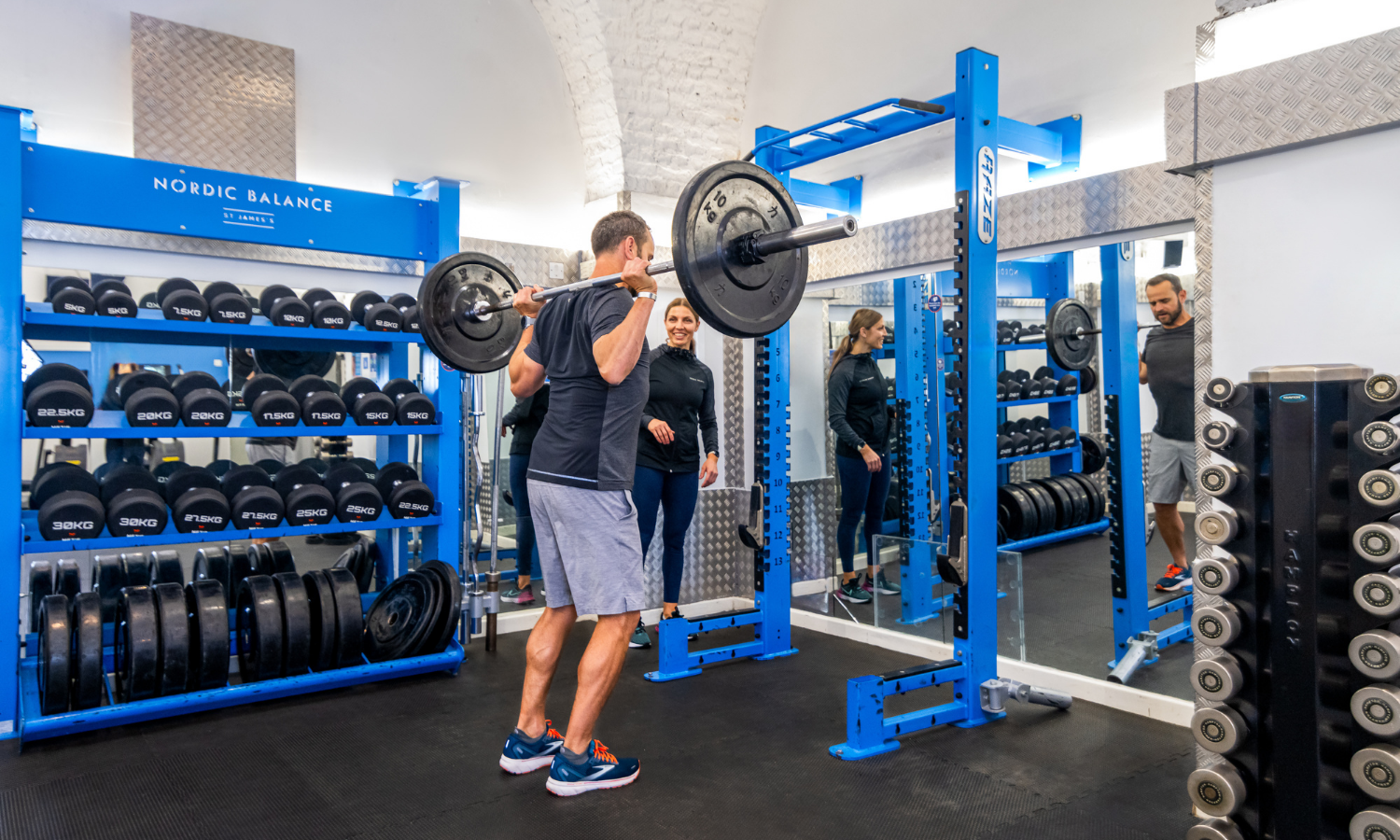

Walk into the weights area at our St. James’s gym, and you’ll find barbells, dumbbells and kettlebells ready to use. All three can help you build strength, but each supports slightly different movements and training goals. Understanding those differences can help you choose equipment that suits your experience, the exercises you want to perform and the type of strength you want to develop.
This guide compares barbell, dumbbell, and kettlebell training, including where each works well, what to consider, and why you don’t necessarily need to choose just one.
Barbells, dumbbells and kettlebells compared
Barbells, dumbbells, and kettlebells are all forms of free weights, but their shape, loading, and how you hold them change how you use them. A barbell lets you load weight onto one long bar and is commonly used for squats, deadlifts, presses, and rows. Dumbbells are held independently in each hand, making them particularly useful for unilateral exercises and movements where each side of the body works separately. Kettlebells have a handle positioned above the weight. This lets you use them for conventional strength exercises and more dynamic movements such as swings, cleans, and carries.
Neither is automatically better than the other. The most useful choice depends on your goals, experience and the movement you are training.
Barbell training benefits and considerations
Standard Olympic barbells typically weigh 20kg, with 15kg bars also commonly available. You can then add weight plates as you build strength. Barbells are widely used for exercises including back squats, front squats, deadlifts, bench presses and overhead presses.
Benefits of barbell training
One of the biggest advantages of a barbell is how easily you can progressively increase the load. Once you develop good technique, you can add small amounts of weight over time, making it straightforward to measure progress and build strength systematically.
Barbells are particularly useful when your goal is to build strength in compound movements that involve several large muscle groups. They can also be used for faster, more explosive exercises such as cleans, snatches and push presses, although these require more technical skill.
Things to consider with barbell training
Barbell training lets you lift substantial loads, so technique and proper progression matter. Adding weight before you can control the movement can change your technique and increase the stress placed on muscles and joints.
Some barbell exercises also keep both sides of the body working together. While that helps develop overall strength, adding unilateral or single-limb exercises elsewhere in your programme can help you train strength and control on each side independently.
Strength is also task-specific. Becoming stronger at a barbell squat, for example, does not automatically make you equally strong in every movement or activity.
Dumbbell training benefits and considerations
Dumbbells come in a wide range of weights and can be used individually or in pairs. Because you control each weight separately, dumbbells give you considerable freedom in how you position and move your arms and legs.
Benefits of dumbbell training
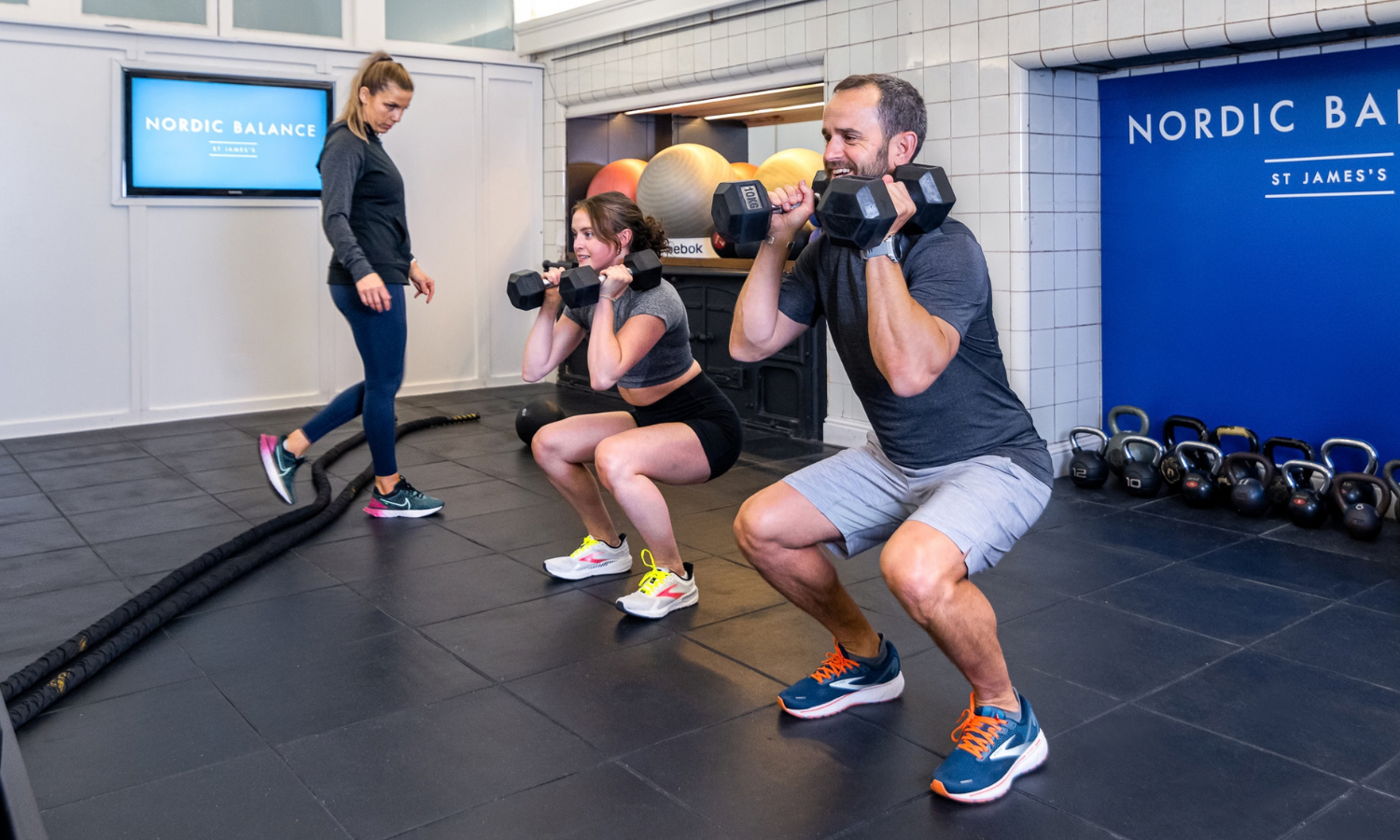
Dumbbells are particularly useful for training each side of the body independently. Exercises such as split squats, single-arm rows, presses, and lunges can help develop strength and control without relying on the opposite side. They also allow more freedom of movement than a barbell in many exercises. This can make it easier to adjust your position or range of motion to suit your mobility and the exercise you are performing. Like barbells, dumbbells can be progressively increased in weight as your strength develops. They are also extremely versatile. The same pair can be used for strength work, carries, circuits and exercises involving several planes of movement.
Things to consider with dumbbell training
Greater freedom also means you need to control the weights throughout the movement. Your technique, stability and choice of load become increasingly important as the weight increases.
Heavier dumbbells also bring a practical consideration. Getting them safely into position for exercises such as presses can be challenging before the exercise even starts.
If you are progressing towards heavier loads, learning how to set up and finish the exercise safely is part of the skill.
Kettlebell training benefits and considerations
Kettlebells place the weight beneath the handle rather than directly in the hand. That changes how the load behaves and makes kettlebells particularly suited to exercises involving carries, swings, and other dynamic, whole-body movements.
Benefits of kettlebell training
Kettlebells can be used for conventional strength exercises such as squats, presses, rows, and lunges, but their design also allows movements such as swings, cleans, and Turkish get-ups. These exercises can challenge several areas at once, including strength, coordination and control.
Dynamic kettlebell exercises can also raise your heart rate considerably, making them useful when combining resistance training with more conditioning-focused work. Carries, single-sided exercises and exercises where the kettlebell moves around the body can also challenge your trunk and stability in different ways.
Things to consider with kettlebell training
Some kettlebell exercises are technically demanding. A kettlebell swing, for example, is not simply a squat while holding a weight. Learning how to generate and control force through the hips is an important part of performing the movement well. Starting with simpler movements and an appropriate weight gives you time to learn the technique before adding speed or load. Grip strength can also limit you during exercises involving repeated swings or carries. If you are experiencing back, shoulder, or other joint pain, you may need to adapt the exercise or load rather than simply push through discomfort.
Choosing the right weights for your training
Your choice of equipment should come back to what you are trying to achieve. Barbells are particularly useful for progressively loading large compound exercises and developing higher levels of strength. Dumbbells give you greater freedom of movement and make it easy to train each side independently. Kettlebells lend themselves particularly well to dynamic movements, carries, and sessions that combine strength with conditioning. For most people, however, there is no reason to choose one and ignore the others.
A programme might include a barbell squat as the main strength exercise, dumbbell exercises to work each side independently and kettlebell carries or swings for a different training stimulus. The equipment is simply a tool. How you use it, how consistently you train and how appropriately you progress the load will have a much greater influence on your results.
Safe and effective strength training
Whichever weight you use, start with a load you can control while you learn the movement. Good strength training is progressive. As your technique, confidence, and capacity improve, you can make the exercise more challenging by increasing the weight, repetitions, range of movement, or complexity.
You do not need to make every workout harder than the last. Progress comes from applying enough challenge to stimulate adaptation while still giving your body time to recover. If you are new to resistance training, returning after a break, or unsure how to structure your programme, a personal trainer can help you choose appropriate exercises, learn the techniques, and build a plan around what you want your training to achieve.
At Nordic Balance St. James’s, our personal trainers can help you use barbells, dumbbells and kettlebells confidently as part of a strength programme designed around your experience and goals.
Build strength with Personal Training at Nordic Balance.